Built-in refrigeration and freezer columns
A Thermador column that drifts warm, frosts up, or has stopped making ice
Built-in refrigerator and freezer columns: temperature that will not hold, frost in the freezer, ice makers that slow down, doors that no longer seal.
Do not run warmer than this
40 °F
What we measure
2 readings
Symptoms we see most
- The fresh-food column drifts above 40 °F and will not come back down
- Frost builds on the freezer walls or on packaged food
- The compressor runs almost continuously
- Ice production has slowed, or cubes come out small, hollow or fused
- The ice maker has stopped making ice altogether
- The door does not pull itself closed at the last inch
- Condensation forms on the cabinet face around the door
USDA guidance for a home refrigerator is 40 °F or below. That number is the useful line for a built-in column, because a column that has drifted to 43 °F looks and sounds completely normal. Nothing beeps. The interior light comes on. The only evidence is that produce is finishing sooner than it used to and the compressor seems to be running more than it did.
Turning the setting colder is the instinct, and it is the wrong move. It masks the symptom for a week or two and adds run time to a system that is already working harder than it should be.
The three families of temperature fault
Columns lose temperature for one of three broad reasons, and telling them apart is most of the diagnosis.
Airflow. Evaporator fan, damper, or a defrost system that has stopped clearing the evaporator coil. A coil that has iced over blocks its own airflow, so the cabinet warms while the compressor runs continuously. This is the most common of the three, and it is a repair rather than a sealed-system job.
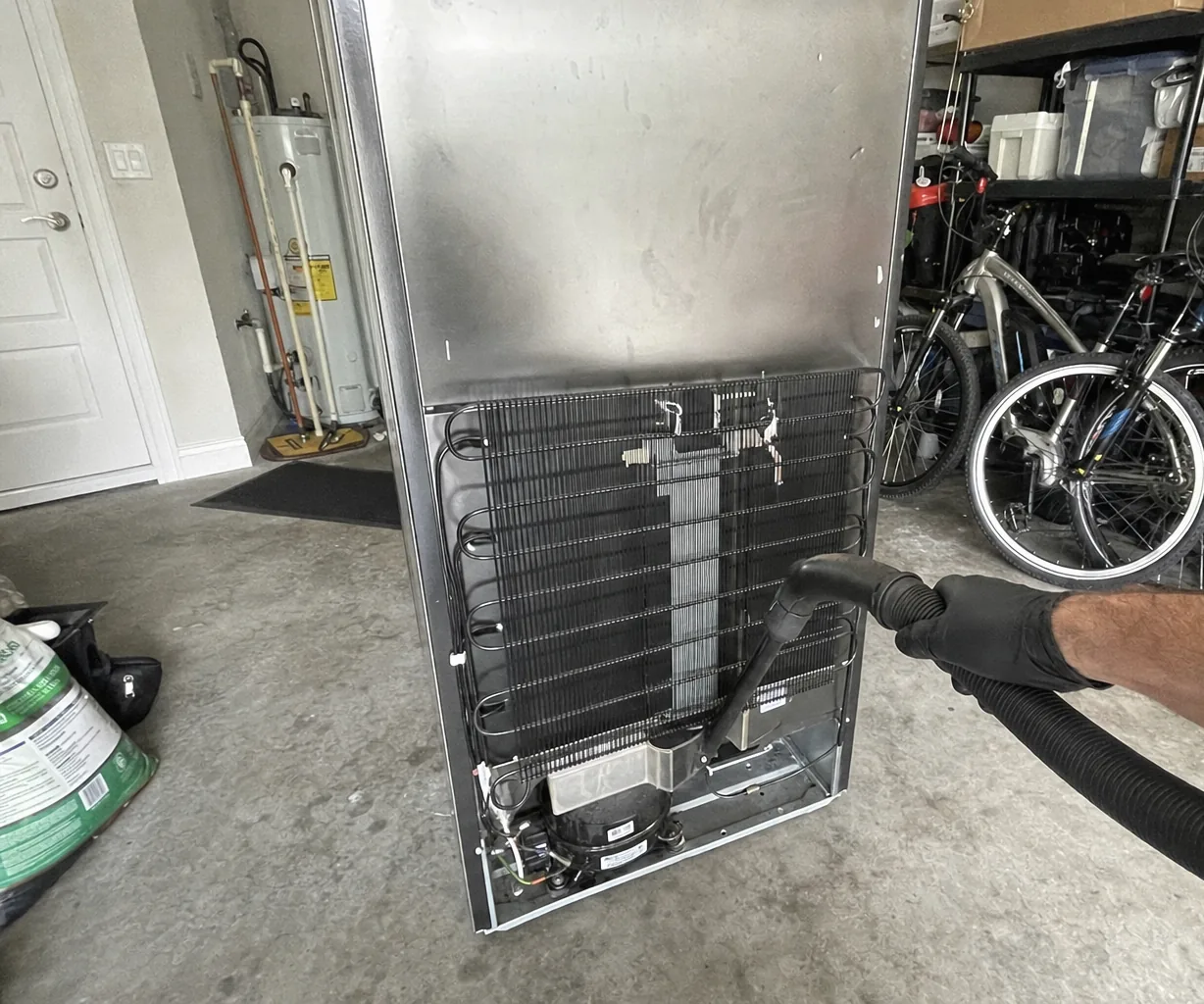
Heat rejection. A built-in column rejects its heat through a condenser behind or above the cabinet. In these kitchens that grille is often behind trim that nobody has removed since the house was built. Dust and pet hair on the condenser raises head pressure, run time and cabinet temperature all at once. It is the one thing on this page you can improve yourself with a vacuum.
Sealed system. A refrigerant loss or a compressor or valve fault. This is the smallest category and the one that carries a federal requirement: sealed-system work here is carried out by EPA Section 608 certified technicians.
Frost is information
Where frost forms tells you what failed. Frost on the freezer walls and the back panel usually points at the defrost circuit — heater, thermostat or control. Frost on packaged food and around the door opening usually points at the gasket or the door alignment, because it is humid Florida air condensing inside a cabinet that is no longer sealing.
A door that no longer pulls itself closed over the last inch is a hinge or a closer-cam question, and it is worth fixing early. A column that stands very slightly open all night ices its evaporator and runs the compressor until morning.
Ice makers, read from the cube
An ice maker is a small machine with four moving pieces — a fill valve, a mold, a mold heater and a harvest motor — and the cube it produces tells you which one is failing before anything is opened.
Uniformly small cubes point at fill volume: the valve is metering short, or the supply line to the appliance is restricted or partly closed. Hollow cubes, or cubes with a soft centre, mean the freeze is being cut short, which is the mold sensor or a cabinet that is not holding temperature. Cubes fused into a slab mean water is arriving between fills, which is a valve that no longer seats fully. A long grinding harvest with cubes that will not release is the mold heater or the motor itself.
Change the filter on schedule regardless, but do not expect it to fix any of the above — a neglected cartridge restricts flow, which produces short fill and small cubes for its own reason, and a fresh one changes nothing about a valve or a harvest motor.
Power events and the compressor
Built-in refrigeration is the appliance in this kitchen most exposed to the electrical supply, because it is the only one running every hour of every day and the only one with a variable-speed drive behind it.
The Jacksonville area averages roughly 68 thunderstorm days a year, and this region has taken multi-day outages — Matthew in 2016, Irma in 2017, Helene in 2024. What we see afterwards is rarely a column that died during the outage. It is one that came back, ran normally for a few weeks, and then started running continuously without pulling temperature, or stopped starting at all. Inverter and control electronics survive a bad supply event and then fail on a component that was left marginal by it.
Two practical consequences. A whole-house surge device at the panel costs a fraction of one control board. And if your column has been odd since an outage, say so when you book — it changes what we test first and it can change what we bring.
What we do
Flat $80 diagnostic, credited toward the repair when you approve the work, written estimate before anything is ordered. We take real temperatures at the cabinet and the evaporator instead of trusting the display, check the defrost cycle, look at the condenser, and only then consider the sealed system. Genuine OEM parts, 90 days on labor, 365 days on parts.
Related
Where this shows up, and what to read next
-
Del Webb Nocatee
Del Webb Nocatee is age-restricted and single-level. Coffee machines run the longest hours here, and oven door hardware takes the most punishment.
-
Coastal Oaks
Coastal Oaks is gated, and its kitchens carry full built-in packages — two columns, a stacked oven pair, a coffee machine, an island rangetop.
-
Twenty Mile
Twenty Mile is a family neighbourhood in ZIP 32081, and household size is what decides which appliance in the package reaches its wear point first.
-
Is a Thermador repair worth it? The arithmetic
The 50% rule applied honestly to a fitted appliance: repair bands on one side, replacement cost on the other, and the cabinet opening in between.
-
How to read an ice-maker fault from the cube
The cube tells you which stage of the cycle is failing before anything is opened. Four shapes, four different parts, and the checks worth doing first.
-
Repair or replace an aging builder package
The honest arithmetic on a fifteen-year-old built-in package: which appliances are worth repairing, which are not, and why the cabinet opening decides.
What it costs
What does a refrigeration column repair in Nocatee cost?
The visit is flat. The repair is a band, because the part it needs is decided at the appliance and not on the phone: below is what this work comes to here, parts and labor together, once the diagnostic has said which one it is.
| Work | Usual range, parts and labor |
|---|---|
| Diagnostic visit | $80 flat, credited to the repair |
| Refrigeration column sealed system | $940–$2,340 |
| Control board or touch panel | $440–$1,040 |
Flat $80 diagnostic covering the visit and the full diagnostic sequence, credited toward the repair once you approve the work. A written estimate follows the diagnosis, and no part is ordered before you have approved that figure. The whole table is on the pricing page.
And if it is cheaper to replace it?
A comparable Thermador wall oven, rangetop or column, appliance only — before delivery, installation or cabinetry. National appliance pricing, not Florida labour.
| Replacing instead | Appliance only |
|---|---|
| Wall oven, the usual repair-or-replace comparison | $4,200–$9,500 |
| Professional rangetop or range | $5,500–$14,500 |
That is the comparison worth making before a board or a sealed system is approved on an appliance that is already tired — and the cabinetry a built-in sits in usually decides it, because a replacement has to fit the opening that is already there.
Questions
Questions we are asked about built-in refrigeration and freezer columns
- How much is a refrigeration column repair in Nocatee?
- The visit is $80 flat and comes off the repair once you approve it. From there the usual band for a refrigeration column sealed system is $940–$2,340, parts and labor together; control board or touch panel runs $440–$1,040. The firm number is written down after the diagnosis, never before it.
- What is the most expensive part to replace on a built-in refrigeration column?
- On a built-in refrigeration column it is the refrigeration column sealed system, at $940–$2,340 parts and labor — the top of the table on this page. The control board or touch panel sits at the other end, from $440. Which of the two the fault turns out to be is settled at the appliance, and the firm figure is written down after the $80 diagnostic, never before it.
- Is it worth repairing a built-in refrigeration column?
- More often than on a freestanding machine. Repairing a built-in refrigeration column runs $440 to $2,340 here, parts and labor across the rows this page prints. Replacing it is $4,200 to $14,500 before delivery, installation or the cabinetry a new unit forces. That gap is the answer, and the diagnostic places you in it.
- The column sits a few degrees warm. Should I just set it colder?
- No. USDA guidance is 40 degrees Fahrenheit or below, and drift above it is a diagnosis rather than a setting. A colder setting hides the symptom for a week or two and adds run time to a system already working hard. We take cabinet and evaporator readings with our own probe instead.
- What does the shape of the ice tell you?
- Uniformly small cubes point at fill volume, so a valve metering short or a restricted supply. Hollow or soft-centred cubes mean the freeze is being cut short. Cubes fused into a slab mean water arrives between fills. A grinding harvest with nothing released is the mold heater or the motor.
Customer feedback
After a built-in refrigeration and freezer columns call in Nocatee
Rated 4.2 out of 5 across 68 customer reviews. Read a spread of them in full.
The unit ran without ever resting and the cabinet still would not get cold enough. He cleaned the condenser, which was thick with dust from the build, and checked the draw against the plate figure afterwards.
Perpetua D.May 2026
Ice had stopped arriving altogether and the bin was bone dry. He checked the supply first and found the shutoff under the sink only part open after some earlier plumbing work, then stayed to watch a full harvest drop.
Clarissa M.May 2026
The freezer column started sounding like a hairdryer overnight. He found the fan blade catching ice that had built up from a blocked drain, cleared the tube and fitted the clip that keeps the heater against it.
Henrietta K.September 2026
Next step
Book a diagnostic visit
Flat $80 diagnostic, credited toward the repair when you approve the work. You get a written estimate before any part is ordered or fitted.
- Diagnostic
- $80, credited to the repair
- Warranty
- 90 days labor · 365 days parts
- Parts
- Genuine OEM parts
- Weekdays
- 8:00am – 6:00pm
Sealed-system work is carried out by EPA Section 608 certified technicians.