Guide · parts
How parts for a built-in appliance are sourced
The serial number decides which part fits, not the model line. What we check before quoting, and why no part is ordered before the diagnostic.
Published Jul 9, 2026 · Updated Aug 14, 2026
Where a repair starts
1 plate
Almost every delay in an appliance repair is a parts delay, and almost every parts delay traces back to something that could have been established at the first visit. This is how that side of the job actually works, because it is the part customers see least and pay for most in waiting.
The rating plate, not the model number
A model number identifies a product line. It does not, on its own, identify what is inside a particular unit.
Built-in appliances are produced over long runs, and components change during them: a board gets a firmware revision, a hinge cassette is redesigned, a seal profile changes, a fan or a valve is replaced by a functionally equivalent part from a different supplier. Which version your appliance has is determined by the serial number, not the model. That is why we read the full rating plate before ordering anything, and why a phone quote for a part is a guess.
The plate is usually on the frame behind the door, on the side of the cabinet opening, or on the back of a drawer front. If you can photograph it before the visit, do — it is genuinely useful.
Superseded parts are normal, and mostly fine
When a component is revised, the original is eventually discontinued and the supplier ships the replacement in its place. That is a supersession, and it is routine rather than a warning sign.
What matters is whether the replacement drops in or needs an adaptation. Some supersessions include a new connector, a different mounting, or a harness adapter in the box. Occasionally the revised part requires a second component to be changed at the same time to work correctly. We check that before quoting, because “the part arrived and it does not fit” is the worst possible outcome for everyone and it is avoidable with one lookup.
Why nothing is ordered before the diagnostic
A part ordered on a description over the phone is a part that has a good chance of being wrong, and the customer usually ends up carrying the cost of that in time, in restocking, or in a second visit.
So the order runs: diagnose, identify the exact component from the plate, check availability and whether it has been superseded, then write the estimate with what we know about the wait. If the wait is long, you find out before you have committed to the repair rather than afterwards.
When a part is not available to us
Some components are not sold to independent trade at all. Sealed-system parts on certain platforms, and occasionally a proprietary control assembly, are distributed only through the manufacturer’s own service channel.
That is a real limit and we say so plainly. If a repair runs into it, the honest answer is that the manufacturer’s channel is where the job has to go, and we would rather tell you that at the estimate than take a diagnostic fee and leave you no further forward. Equally, if your appliance is still inside its original factory warranty, that channel is the right first call anyway.
OEM, and what “equivalent” usually hides
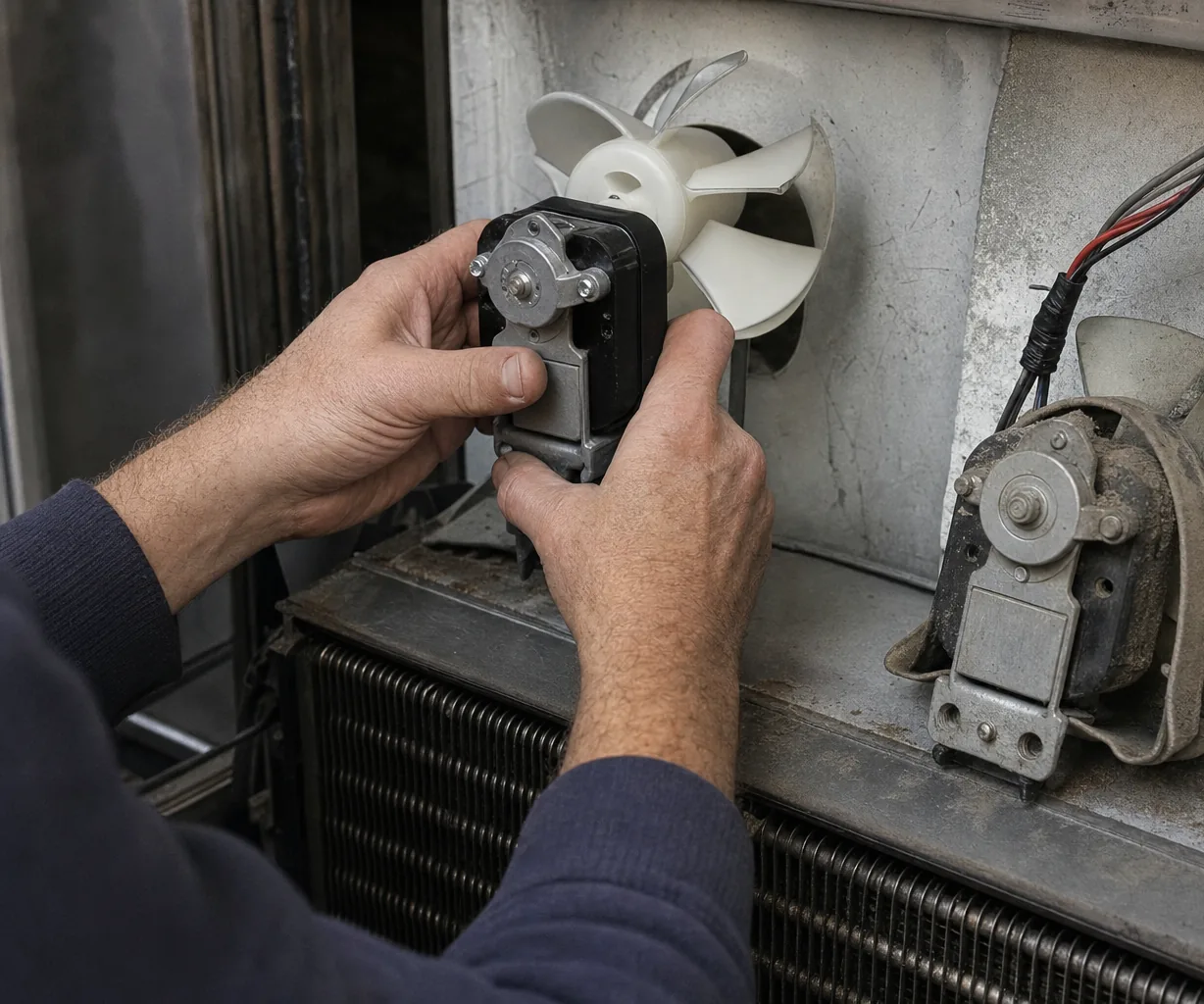
We fit genuine OEM parts. The reason is not brand loyalty; it is that a built-in appliance is a system whose components are matched to each other. A pattern element with a different watt rating, a fan with a different flow characteristic or a thermostat with a different response curve will all fit the hole and change how the appliance behaves.
Where a genuine part is unavailable, we say so and explain the options rather than fitting a substitute and describing it as the same thing.
What this means for an older package
On an appliance that is past fifteen years, availability is part of the repair-or-replace arithmetic rather than a footnote to it. A repair that is sound today on a unit whose control board is already scarce is a different proposition from the same repair on a unit whose parts are current.
We check that before quoting, not after, and we will tell you when the economics point at replacement — including when that means we do not get the job.
Diagnosis is a flat $80, credited toward the repair when you approve the work, with a written estimate before any part is ordered. Repairs carry 90 days on labor and 365 days on parts.