Guide · symptom
Why a Thermador fridge runs too cold and freezes food
Setpoint, cold modes, blocked vents, then sensor and board: the order to work through when a Thermador column turns milk to slush and lettuce to ice.
Published Oct 10, 2026 · Updated Oct 10, 2026
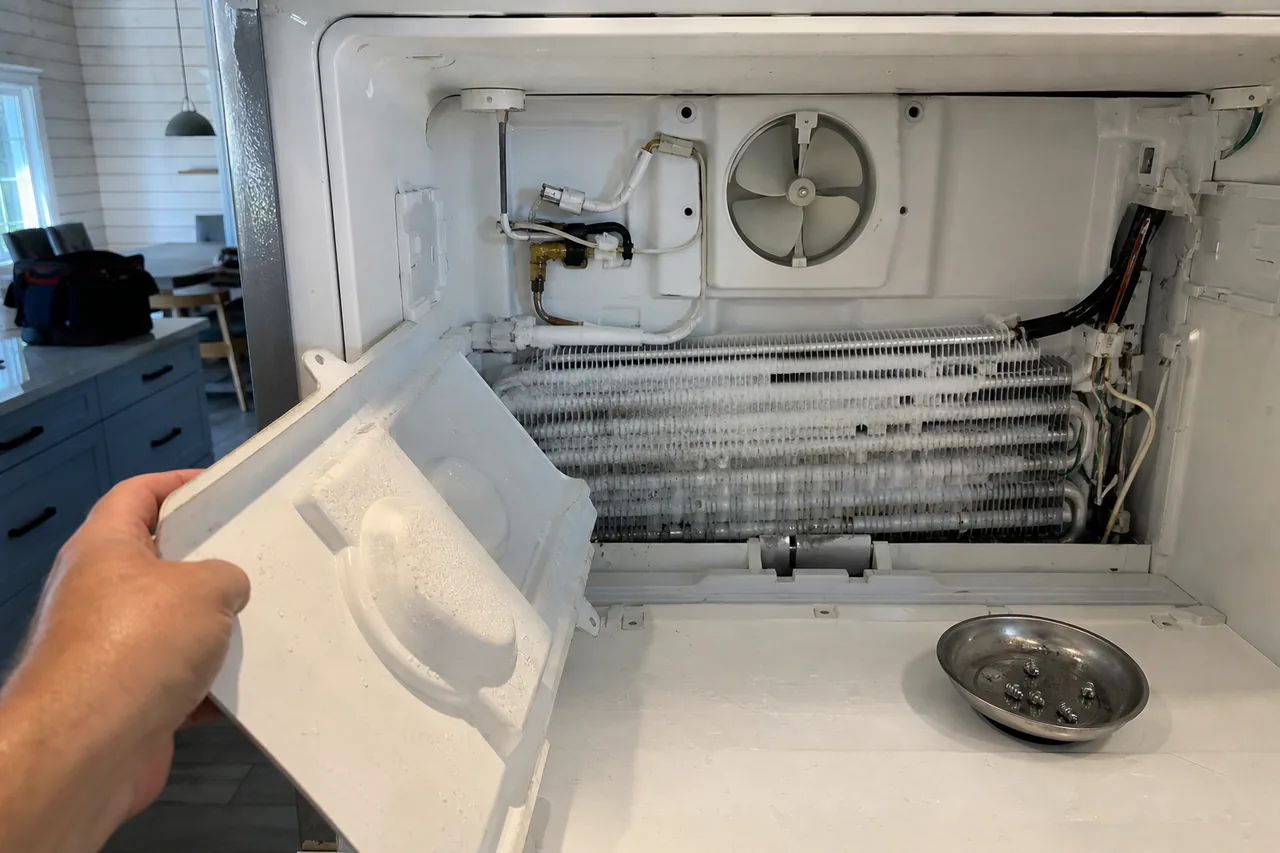
A fridge that freezes everything is nearly always colder than it was told to be, or colder than its owner realises it was told to be. Start with the display: on a Thermador Freedom column the main compartment should read +39°F, Thermador’s own recommendation, and nothing below +36°F keeps food any better. If the setting looks right, confirm Super cooling is off and nothing is pressed against the rear cold-air outlet. Food still freezing after those three checks points to a temperature sensor or control fault, which is a technician’s job.
Read the setpoint first
Federal energy guidance places the fresh-food compartment between 36°F and 40°F and notes that colder settings only raise the power bill, since food lasts no longer below 36°F. Thermador’s use-and-care guide for the Freedom refrigerator columns, covering the T23IR905SP, T24IR905SP, T30IR905SP and T36IR905SP, agrees: +39°F for the cooling compartment, +34°F for the chill compartment, and a main setting that stops at +36°F on the cold end and +46°F on the warm end.
The bottom of that range will not freeze food by itself, but it leaves no margin, so a pocket of air near an outlet can dip below 32°F. Move the setting to +39°F, then measure. Overnight, a thermometer sunk in a cup of water tells you the real food temperature; an air reading by a vent swings each time the door opens.
Settings that chill on purpose
Some features exist to make things colder, and a stray touch while wiping the panel can start one. Super cooling pulls the compartment down hard after a big grocery run; while it runs, everything inside gets colder, so switch it off and give the column a few hours.
Check the drawers too. The 30-inch T30IR905SP has a temperature-controlled drawer adjustable from 30°F to 38°F. At the low end it sits below the freezing point of water, so berries, herbs and greens kept there turn to ice while the shelves above stay normal. That is the drawer obeying its setting, not a fault.
Eco mode makes a handy test in the other direction. It holds the main compartment at +43°F and the cool-fresh container at +35°F. If food still freezes with Eco on, the setting is not your problem.
Where the ice forms is a clue
| Symptom | Likely cause | What you can check | When to call |
|---|---|---|---|
| Only items touching the back wall freeze | Food blocking the cold-air outlet | Leave a hand’s width of space at the rear | If freezing continues with the outlet clear |
| Only one drawer freezes | Drawer set near its 30°F limit | Raise the drawer setting | Rarely needed |
| Whole compartment freezes at +39°F | Temperature sensor reading wrong | Water-cup thermometer overnight | When the cup reads far below the display |
| Fresh side too cold on a bottom-freezer model | Air damper stuck open | Make sure nothing blocks the vents | Once the vents are clear |
When the column cools past its own setting
If the setpoint is sensible, no cold mode is running and the vents are clear, the column is ignoring its instructions, which points at the parts that measure and decide. A refrigerator only knows how cold it is through an electronic temperature sensor. When that sensor drifts and reports a warmer number than the truth, the control keeps calling for cold and the compressor runs on. A control board relay that sticks closed does the same with a healthy sensor. On a bottom-freezer model, a damper jammed open lets freezer air spill into the fresh-food side. None of these are owner repairs: the sensor has to be measured against a known temperature and the board’s outputs checked while the unit runs.
What to have ready, and what a visit costs
Write down the E-Nr and FD numbers first. Thermador prints them on the rating label inside the fresh-food compartment, on the right-hand side close to the door, and they let the correct sensor or board be identified before anyone arrives. Note the display setting, your water-cup reading and whether any mode was on.
Palm Row Appliance Co. is an independent service, and every visit starts with the $80 diagnostic. If the control board proves to be the fault, that repair typically falls in the $440–$1,040 range, with the firm figure following the diagnosis. Until then, nudging the setpoint a few degrees warmer often stops the freezing and saves the groceries.